'Microscope'
A microscope is an instrument used to see objects that are too small to be seen by the naked eye. Microscopy is the science of investigating small objects and structures using such an instrument. Microscopic means invisible to the eye unless aided by a microscope.
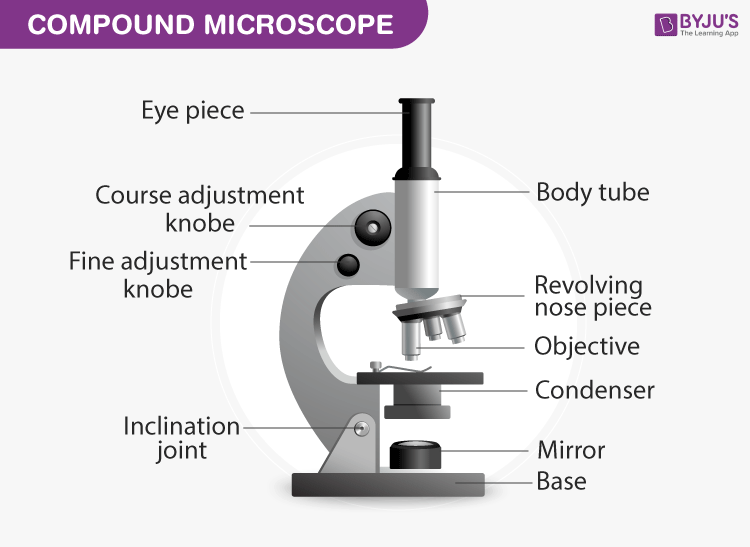
- Parts and Function -
Eyepiece - The objective lens or mirror collects light and brings it to focus creating an image. The eyepiece is placed near the focal point of the objective to magnify this image.
Course adjustment - The coarse adjustment knob located on the arm of the microscope moves the stage up and down to bring the specimen into focus. The gearing mechanism of the adjustment produces a large vertical movement of the stage with only a partial revolution of the knob.
Fine adjustment - This knob is inside the coarse adjustment knob and is used to bring the specimen into sharp focus under low power and is used for all focusing when using high power lenses. Light Source - The light source in your microscope is a lamp that you turn on and off using a switch.
Neck - used to carry the microscope, structural element that connects the head of the microscope to the base.
Stage - The flat platform that supports the slides.
Stage clips - Stage clips hold the slides in place.
Light source - Illuminator: A steady light source (110v) used in place of a mirror. If your microscope has a mirror, it is used to reflect light from an external light source up through the bottom of the stage.
Base - Used for support.

No comments:
Post a Comment
Note: Only a member of this blog may post a comment.